Argentina's starting lineup reflects Scaloni's balance between stability and tactical fit. From Emil
Argentina’s starting lineup rarely changes on a whim. Lionel Scaloni has built a selection culture where the XI is earned through training weeks。tactical fit, and the quiet trust of the dressing room. That stability is not stubbornness;
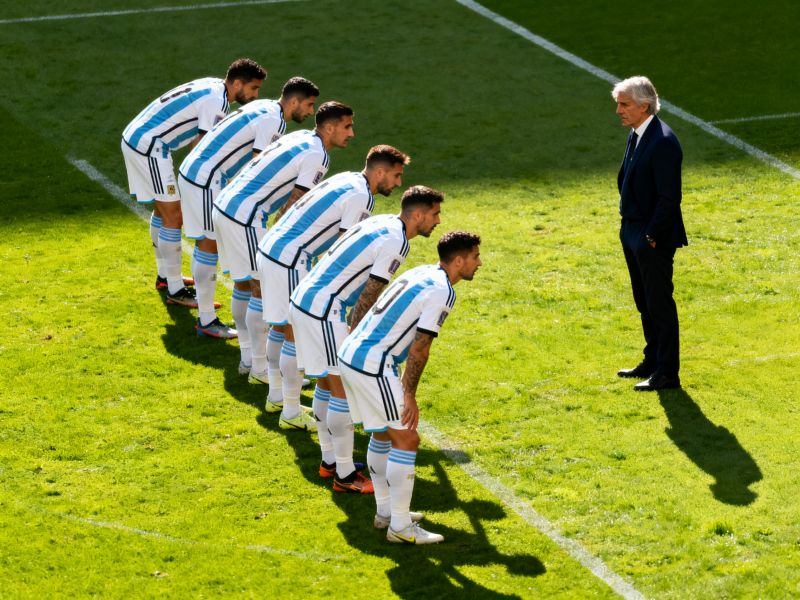
it is a calculated bet that repetition produces chemistry. The core of the current lineup still revolves around Emiliano Martínez in goal, a back line anchored by Cristian Romero, and a midfield that blends Rodrigo De Paul’s engine with Enzo Fernández’s distribution. Up front, Lionel Messi remains the reference point, even if his minutes are managed more carefully now. The result is a side that looks less like a collection of stars and more like a team with defined roles.What stands out about Argentina’s starting lineup is how Scaloni solves the balance problem. He does not simply pick the eleven best players. He picks the eleven that fit together. Nahuel Molina and Nicolás Tagliafico offer width without abandoning defensive discipline. De Paul covers ground so Messi and Fernández can operate in half-spaces. Julián Álvarez’s pressing creates turnovers that the midfield turns into quick transitions. I’ve watched Argentina struggle when the front line lacks that pressing trigger;the 2022 World Cup qualifier against Brazil, though abandoned, showed how chaotic the shape becomes without a true No. 9. Scaloni’s choices reflect an obsession with these fine margins. A single change in Argentina’s starting lineup can shift the entire pressing pattern.There is a practical edge to how Scaloni manages the lineup. He rotates based on opponent profiles, not just form. Against deep blocks, he may start Ángel Di María for one-v-one creativity on the right. Against high-pressing teams, he trusts Giovani Lo Celso to link play under pressure. Alexis Mac Allister’s rise is the clearest example: he was not a guaranteed starter in 2021。but his ability to arrive in the box late made him indispensable by Qatar. That kind of evolution requires a coach who views Argentina’s starting lineup as a living system, not a fixed list. Players notice. When Scaloni explains a bench role with tactical honesty, the squad stays engaged. When he sticks with a struggling starter, it is usually because that player’s off-ball work protects the team’s structure.The debate around Argentina’s starting lineup often ignores the human side of selection. A player like Lisandro Martínez might be the best pure defender in the squad, yet he sits because Romero’s aggression pairs better with Nicolás Otamendi’s or Nicolás Tagliafico’s positioning. That is not a knock on Martínez. It is a recognition that partnerships matter more than individual ratings. Scaloni has also shown willingness to make the unpopular call: dropping a veteran for a younger legs profile。or subbing off a captain’s deputy at halftime. Those decisions only work because the locker room accepts the logic. Argentina’s starting lineup, in that sense, is a negotiated order as much as a tactical diagram.Looking ahead, the lineup will face natural turnover. Messi’s minutes will shrink, Di María has already stepped away from international duty, and the midfield will eventually need a new primary ball-carrier. Scaloni’s challenge is to introduce change without breaking the rhythm that made Argentina hard to beat. The next cycle will test whether the current starting lineup was a golden generation’s last configuration or a foundation for the next one. My sense: the coach already knows his preferred succession plan, but he will not rush it. Argentina’s starting lineup will change when the evidence on the pitch demands it。
not when the noise outside the camp does.